

Our Services
Let’s Start Work
Together
Please feel free to contact us. We will get back to you with 1-2 business days. Or just call us now.
Tanjong Pagar (Sales Office):
100 Tras Street 100 AM,
#13-03, Singapore 079027
+65 6970 1280
pf.tanjongpagar@pentasflora.com.sg
Jurong (Operation Office):
42A, Penjuru Road #0100, Singapore 609164.
+65 9811 5599
pf.jurong@pentasflora.com.sg
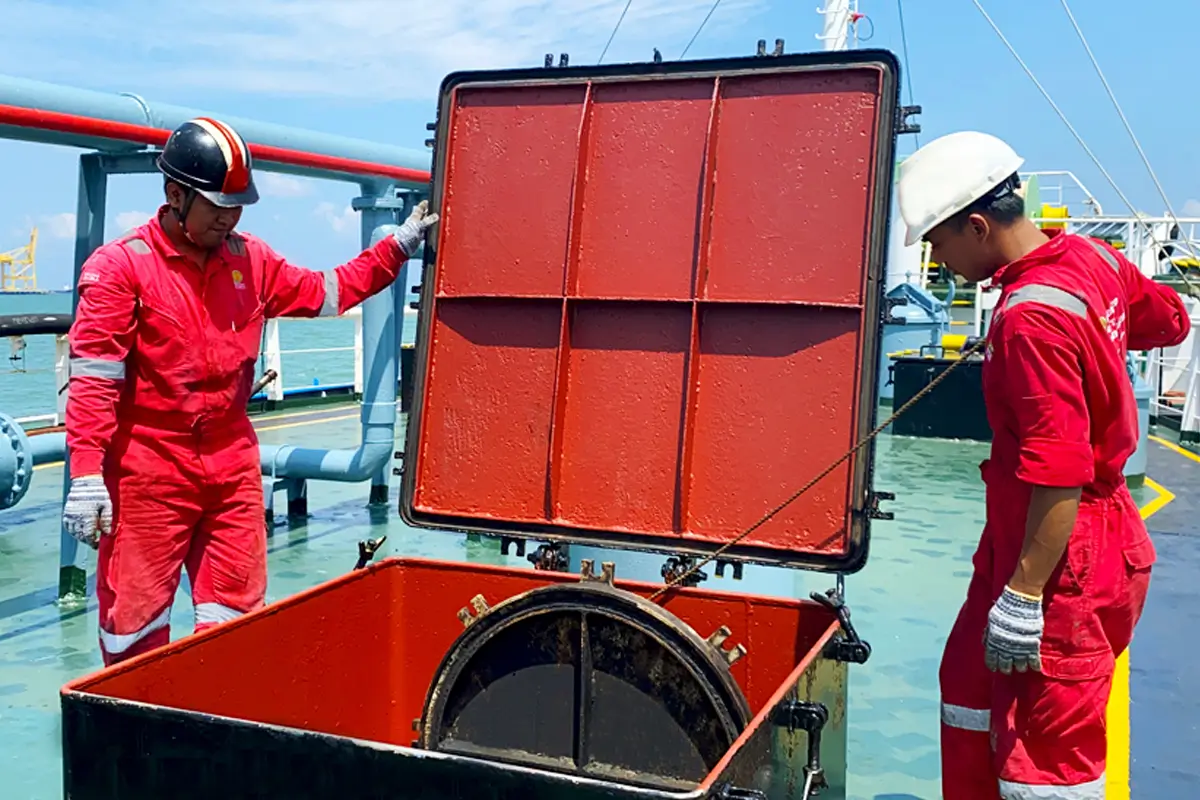
What is Vessel Tank Cleaning
Tank cleaning is the process of removing hydrocarbon vapours, liquids or residues. We provide cleaning services to oil tankers, shipping vessels, and other waterborne vessels. Our experienced teams clean engine rooms, pump rooms, storage rooms, bilge tanks, slop tanks, fuel oil tanks and oil spills.
Tank cleaning may be required for one or more of the following reasons:
- To gas free tanks for internal inspections, repairs or prior to entering dry dock.
- To remove sediments from tank top plating.
- To load a different and not compatible grade of cargo.
Our standards in Hot Work is shown in our service
- Afloat cleaning/rafting to remove all oily residue from the entire tank interior, top to bottom, up to hot work standard.
- Removal of mud/scale by hosing down the tank to dilute the mud and pumping out all muddy water.
- Cleaning of miscellaneous tanks in the engine room, such as sludge tanks, bilge tanks, and lobe oil settling tanks.
- Removal of all sediments and diesel/chemical mopping in FOT -Degrease and wash down Pumproom -Provide lighting, ventilation, and assistance to UT surveyor for tank gauging and inspection.
- Appointment of an independent chemist for gas-free and tank-cleaning inspections, as well as hot work certification.
- Empty the tank as much as possible; strip the tank by trimming the ship forward or aft depending on the suction valve location.
- When the ship is going for dry-dock the keel plan is to be sent to the shore facility so that they should not put any keel block in the way of the plug present at the bottom shell plating.
- The tank has to be properly ventilated as it is an enclosed space and might contain flammable gases.
- It is to be made sure that the steam connections are closed and proper signs and placards are displayed so that during cleaning, nobody opens the valve and gets burnt or hurt.
- The tank has to be checked for flammable gases.
- The tank has to be checked for oxygen content with the help of oxygen analyser.
- The tank is drained of left over oil with the help of plugs.
- The location of plug can be found in shell plating diagrams.
- Generally, this plug is covered with cement and made streamlined with the shell plating.
- Enclosed space entry checklist is filled out so that no safety issues are compromised or left.
- Entry is only to be made inside the tank if the oxygen level is 21% by volume and flammable gases are vented out.
- One person should always standby outside the manhole door and should be in communication with the person inside.
- The person outside should continuously communicate with person inside and with the duty officer.
- In case of hot work to be carried out, a fire line is to be carried inside. Also, a small fire extinguisher for small fire should be there. Inform Port state authority before commencing hot work.
- The tank is cleaned manually with the help of brushes, rags etc.
- The oxygen content is continuously monitored and in case the alarm indicates low level, the space has to be evacuated immediately without any delay.
- Make sure no tools are left inside which may get stuck in the valve or damage the transfer pump
- The place where crack repair is done should be checked for leaks.
- If it is a steam leak repair, the coils need to be checked for steam leak inside.
- In case of crack or plate renewal the tank has to be pressure tested and checked for leaks. If the repair is major it has to be inspected by class surveyor before putting it in operation.
- Close the manhole after inspection, repairs and cleaning.
- Close and remove the sign – permit to work.